
HUMAN OR ENTERPRISEDefine policy + mandate
RIGHTS INFRASTRUCTURE FOR THE AI ERA
AI Product Rights Readiness for commercial delivery.
Define any digital product—from media, games, software, and data to AI models, services, and entitlements. Give people and AI Agents an explicit, reviewable path to create, use, and deliver it without inventing authority.
For AI content studios, agencies, and software, media, marketing, or digital-product teams using multiple models to deliver commercial work. The underlying architecture remains universal across all digital products.
- Four locally validated adapter paths—not hosted production integrations
- Policy-governed
- Reference—not hosted production
- Provider-neutral
GOVERNED MACHINE EXECUTIONOne contract. Many Agents.
LOCAL REFERENCE · TESTEDLOCALLY VALIDATED REFERENCE ADAPTERSOpenAI · Anthropic · Gemini · MCP
PolicyDecision.v1Allow · Deny · Require human
ATTRIBUTABLE OUTPUTDigital product + audit event
THE RIGHTS LAYER FOR HUMAN + MACHINE ECONOMIES
AI creates at machine speed. Rights still move by hand.
Blessbri is building digital-product rights infrastructure for people, organizations, software, and AI—understandable today, machine-readable by design, and verifiable over time.
- Any digital product
- Human-approved
- Machine-readable
- Local-first
COMPOSITE DIGITAL PRODUCTMarketing Campaign
Human reviewed
Hero imageAI + designer
Campaign videoHuman footage + AI editing
Campaign copyAI draft + human revision
Voice trackAI-generated
Brand markHuman-created
ONE REVIEWABLE PRODUCT RECORD
Product GraphProvenanceRightsEvidenceDelivery
REAL PRODUCT WALKTHROUGH
An AI-made film. One continuous rights workflow.
An AI agent creates an original animated short; actual RC3.24 captures then show how Studio records its source, rights, signed package, and local integrity result.
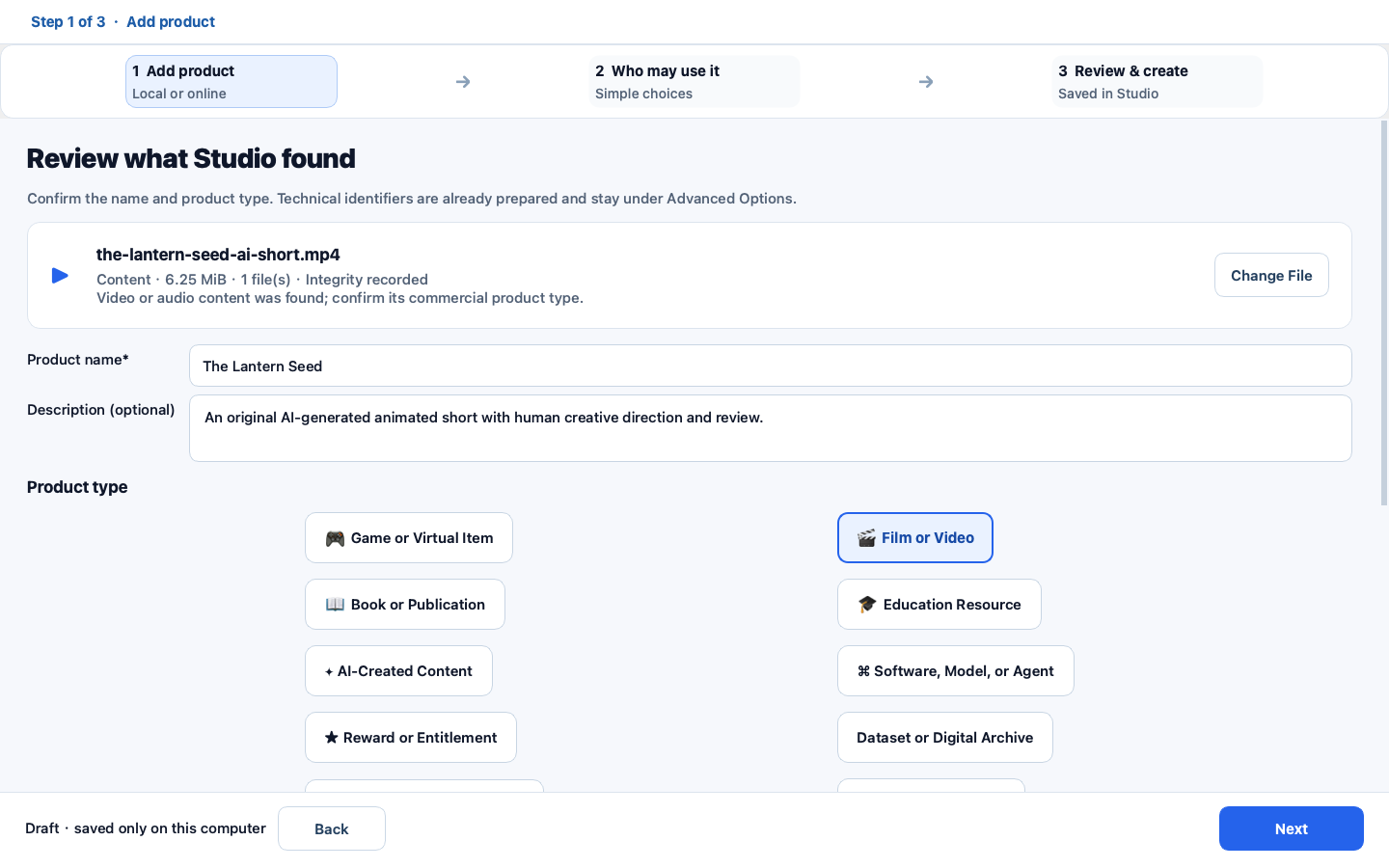
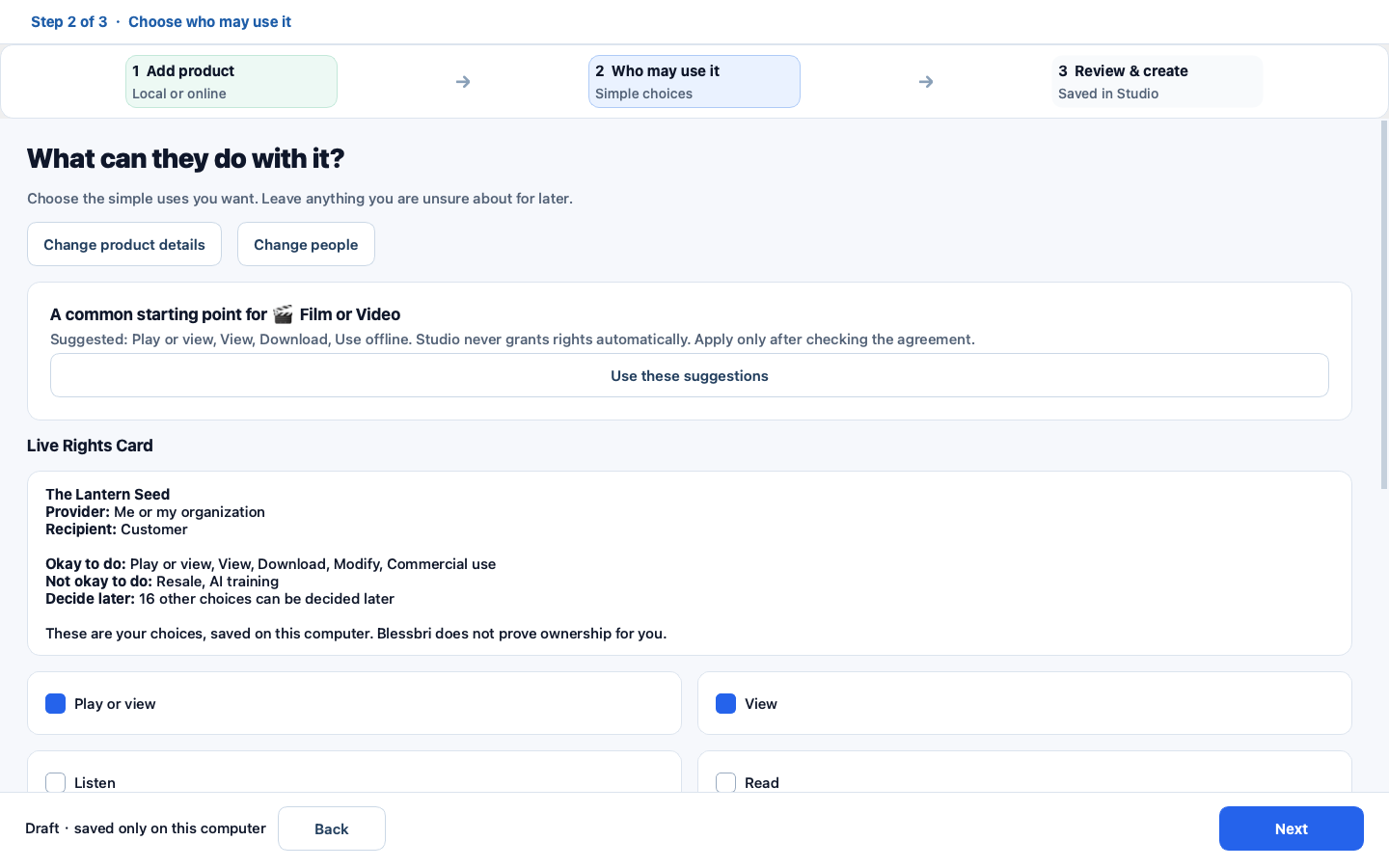
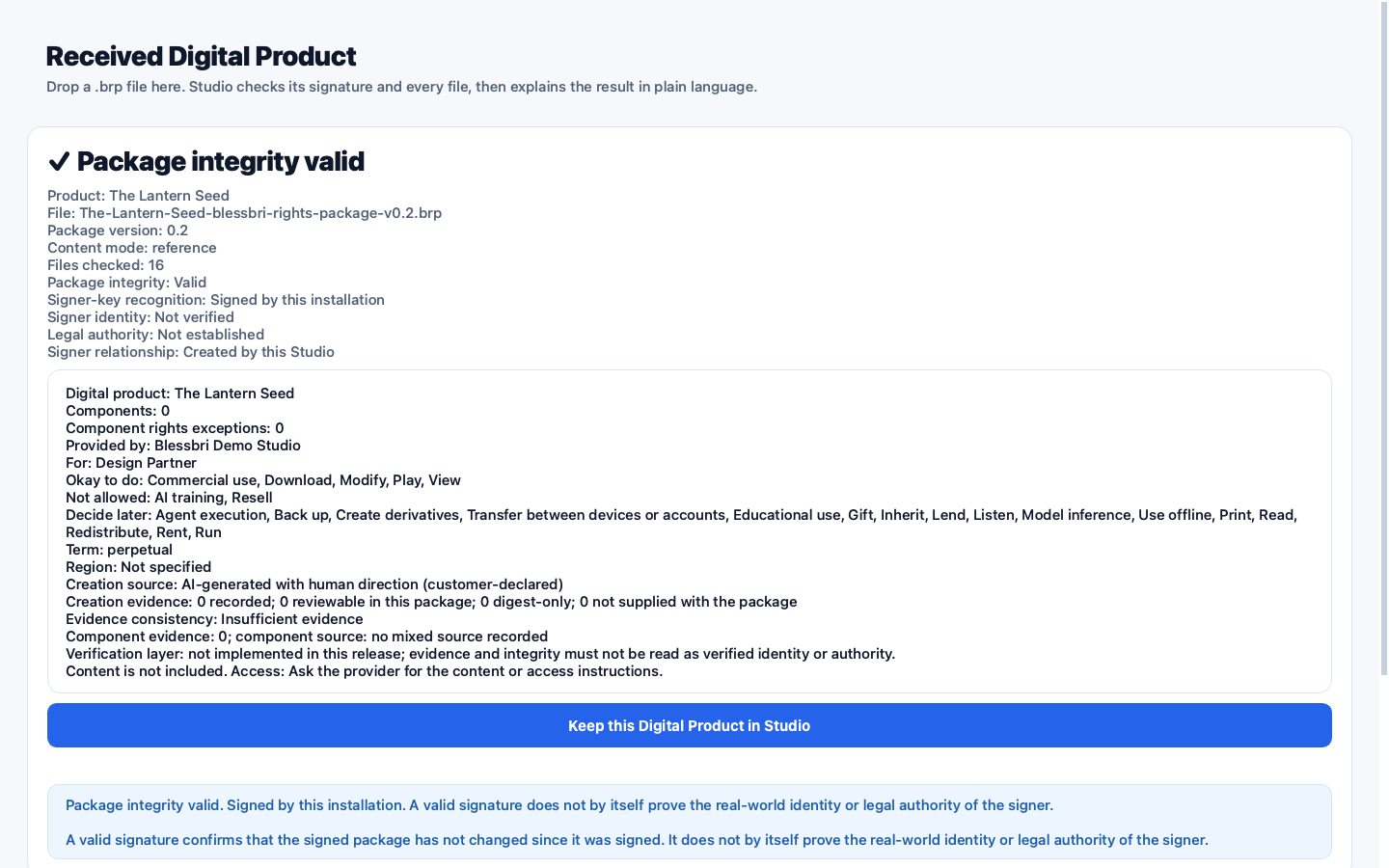
Real RC3.24 captures from the same AI-animation-to-package run. The original demo asset is synthetic; Studio's import, records, export, and inspection are real and local.
The world can generate infinite digital products. It still cannot govern their rights at the same speed.
AI continuously produces media, software, models, datasets, services, and countless product variants.
Creators, models, contractors, licenses, restrictions, and evidence remain scattered across files, platforms, and messages.
Software and AI need explicit, versioned rights—not ambiguous documents that only one person understands.
HUMAN CONTROL PLANE
People define authority. Policy sets the boundary.
Studio lets people and organizations structure any digital product, state provenance and rights, issue an Agent Mandate, and decide which actions may run automatically or require review.
See the human workflow →AI EXECUTION PLANE · AVAILABLE LOCALLY
Agents execute within explicit limits.
The current Founder build provides a local Agent Bridge, standard MCP stdio service, provider-neutral contracts, PolicyDecision.v1, trusted gateway metadata, audit, revocation, rate limits, anti-replay, and reference SDKs. Embodied systems can adopt the same interface after runtime and device trust gates are completed.
Open Agent integration →FOR HUMANS
People define the rules.
Studio helps people and organizations structure products, state provenance, choose rights, review evidence, approve delivery, and retain a local record.
See the human workflow →FOR SOFTWARE + AI
Machines read the result.
Signed, structured Rights Packages are machine-readable today. Governed APIs, SDKs, policy decisions, credentials, and event interfaces remain staged roadmap capabilities.
See the machine roadmap →Trust that can evolve without locking the world to one server, cloud, or chain.
Product Graphs, provenance statements, rights, hashes, signed .brp packages, and browser-local integrity inspection.
Enterprise governance, issuer trust, status, replay, verification, reconciliation, and independently checkable public evidence.
Cryptographically agile, standardized hybrid post-quantum protection and optional high-throughput blockchain reference deployments—only after earlier trust stages mature.
ILLUSTRATIVE WORKFLOWS
See where Blessbri fits before reading the architecture.
These are product examples, not customer testimonials. They show how the same rights workflow applies across different digital products.
A publisher or buyer can review each component’s provenance, terms, evidence, and restrictions without reducing the whole product to one file.
The team creates a readable product record and Rights Package for financing, acquisition, licensing, or delivery while keeping legal verification separate.
A campaign can connect generated media, human edits, commercial-use terms, training restrictions, evidence, and required approvals by component.
A case study should show completed work—not borrowed credibility.
Every Founder Pilot starts with one real workflow and agreed deliverables. Blessbri publishes customer evidence only after the work is complete and the customer approves what may be shared.
A reviewable Product Graph, provenance and rights records, an evidence inventory, one or more .brp Rights Packages, and repeatable handoff notes.
The before-and-after workflow, actual product and package created, completion time, approved feedback, and whether the customer returned to use the workflow again.
No customer case study is presented as evidence until it is completed and approved for publication.
START WITH WHAT EXISTS TODAYBring one real digital product.
Request a Founder PilotOrganize its components, provenance, rights, evidence, and delivery record in one guided pilot with an agreed scope and concrete deliverables.
Blessbri records customer-provided statements and technical integrity evidence. It does not independently verify legal ownership, identity, authority, or platform acceptance.
Digital products move at machine speed. Governance still moves by hand.
The problem is no longer just storing files. It is keeping every product, component, creator, tool, right, restriction, and decision understandable as volume grows.
AI and automation produce content, software, media, datasets, services, and variants continuously.
One product can combine human work, contractors, licensed assets, software, and multiple AI systems.
People, organizations, applications, devices, and future agents all need the same product context.
Use, modification, distribution, AI training, transfer, and approval cannot remain hidden in scattered documents.
Humans define the rules. Machines use the structured result.
Blessbri Studio is designed for human understanding and approval. Future interfaces can use the same explicit product structure without turning the desktop UI into a machine API.
Review, decide, approve
- Define the product and its components
- Declare provenance and attach evidence
- Choose rights, restrictions, recipients, and terms
- Approve delivery and retain an audit trail
Read, evaluate, automate
- Stable identifiers and explicit versions
- Machine-readable product and rights state
- Deterministic decisions with explanations
- Idempotent operations and structured events
Give automation a governed path—not hidden authority.
A future agent should act for a responsible principal, under an explicit mandate, against understandable digital product rights, with every action producing a reviewable event.
Principal→Agent→Mandate→Product rights→Action→Audit event
Studio · Product Graph · provenance · rights · evidence · signed .brp packages
API · SDK · policy decision interface · credential interface · structured events
Governed agent execution · cross-platform verification · payment-rail-neutral authorization
Automate repetitive work—not legal judgment.
Blessbri keeps technical processing in the background while the consequential decisions remain visible to a person.
- Detect type, size, extension, and hash
- Build and check component structure
- Connect declarations, evidence, and delivery context
- Generate reviewable records and rights packages
- Whether ownership and authority claims are accurate
- Which rights and restrictions should apply
- Whether evidence is sufficient for the purpose
- Whether to release, approve, or authorize an agent
THREE FIRST-CUSTOMER GROUPS
Start where AI-assisted commercial delivery creates an immediate rights-evidence problem.
AI content studios and creative agenciesMulti-model software, media, and marketing teamsDigital-product, licensing, and diligence teams
START SMALL
Start with one real digital product.
Organize its components, provenance, rights, evidence, and delivery record in one guided workflow.
Request a Founder PilotBlessbri organizes declarations, evidence, rights terms, and delivery records needed for governance and diligence. It does not independently prove legal ownership.
WHO NEEDS BLESSBRI
Find your problem. See what changes today.
Blessbri is most useful when one digital product contains many files, contributors, tools, licenses, or delivery promises.
Which assets used AI?
Can this be used commercially?
Which component has restrictions?
Is the evidence ready for diligence?
01
WHO NEEDS IT
AI-enabled creative teams
WHAT BREAKS
The team cannot answer which components used AI, which tools were involved, or where human review happened.
WHAT BLESSBRI DOES NOW
Creates a component-by-component provenance inventory with declarations and supporting evidence.
02
WHO NEEDS IT
Publishers and product teams
WHAT BREAKS
Music, code, subtitles, images, DLC, documents, and contractor work carry different rights and evidence.
WHAT BLESSBRI DOES NOW
Connects components, rights, restrictions, provenance, and evidence in one Product Graph.
03
WHO NEEDS IT
Studios, agencies, and supplier networks
WHAT BREAKS
Months later, nobody can clearly tell what was delivered or whether it may be modified, commercialized, redistributed, or used for AI training.
WHAT BLESSBRI DOES NOW
Produces a readable, machine-readable Rights Package and a local delivery record.
04
WHO NEEDS IT
Founders preparing financing, licensing, an IP sale, or acquisition diligence
WHAT BREAKS
Investors and buyers ask who made each asset, which tools were used, where licenses are, and which components carry restrictions.
WHAT BLESSBRI DOES NOW
Organizes declarations, evidence, rights terms, component relationships, and delivery records before diligence begins.
05
WHO NEEDS IT
Organizations setting internal AI governance
WHAT BREAKS
There is no repeatable check before AI-assisted assets or supplier deliveries enter production.
WHAT BLESSBRI DOES NOW
Supports an internal rule that requires a Rights Package and human review before approval.
THE IMMEDIATE RESULTProduct Graph + Provenance + Rights + Evidence
Bring one real product
One reviewable record replaces scattered folders, license files, spreadsheets, and email threads.
Blessbri organizes declarations, evidence, rights terms, and delivery records. It does not prove legal ownership or replace legal review.
OFFICIAL WORKED EXAMPLE
Follow one composite digital product from source to Rights Package.
This RC3.24 demonstration begins with an original AI-agent-created animated short, then follows the real file through AI provenance, rights decisions, signed .brp export, and local integrity inspection.
90-SECOND REAL DEMO
AI creates the film. Studio keeps its context.
Follow the complete chain: an explicitly labeled illustrative AI Agent receives the brief, plans and creates the animation, saves the MP4, then the shipping RC3.24 interface imports that exact file, records its provenance and rights, exports a signed .brp, and reopens it with valid local integrity.
RC3.2490 secondsIllustrative Agent processReal Studio workflowSigned .brpLocal integrity: valid
01Input: Northstar Campaign
One campaign folder contains five components created in different ways.
JPG
Hero photographHuman captured · tool-assisted edit
MP4
Launch videoHuman footage · AI-assisted edit
WAV
VoiceoverAI-generated · human reviewed
DOC
Campaign copyAI-assisted · human revised
PDF
Brand guideHuman-created reference
02Studio organizes
- Stable component IDs, order, required status, and dependencies
- File hashes and available metadata captured locally
- Provenance declarations and evidence references per component
- Allowed uses, restrictions, duration, issuer, and recipient
- Human confirmation before package creation
03Output: northstar-campaign.brp
B
Blessbri Rights PackageReadable by people · structured for software
- Manifest and Product Graph
- Component provenance and evidence references
- Rights Card and delivery record
- Hashes and local package-signature result
INTEGRITY CHECKED
A readable result, not another mystery file.
The same package can be reviewed in plain language while retaining the structured product, component, provenance, rights, and delivery data.
Clear boundary
Blessbri organizes customer declarations, evidence, rights terms, and delivery records and can expose later integrity changes. It does not prove legal ownership, verify third-party identity, or replace legal review.
PRODUCTNorthstar Campaign
PARTIESDemo Studio → Campaign Client
COMPONENTS5 ordered components
ALLOWEDPublish · Display · Local adaptation
RESTRICTEDNo resale · No AI training
PROVENANCECustomer-declared · evidence referenced
PACKAGE SIGNATUREValid local integrity signature
SIX CLEAR STEPS
From source to signed Rights Package.
- 1
Add the source
Choose a file, folder, package, or URL.
- 2
Detect and hash
Capture available type, size, metadata, and integrity hashes.
- 3
Add components
Keep every meaningful file or service in one ordered product graph.
- 4
Record provenance
Declare how each component was created and attach supporting evidence.
- 5
Define rights
Choose participants, permitted uses, restrictions, and duration.
- 6
Generate the package
Create a readable, integrity-protected delivery record.
INPUTAny digital product source
HUMAN CONTROLRights remain explicit and reviewable
OUTPUTSigned .brp + local delivery record
THE EXPERIENCEAdd the product. Make the decisions. Keep the evidence.
Complex processing stays behind the interface while every important human choice remains clear.
PROFESSIONAL VIEWOpen technical and governance detailsFor technical reviewers, security teams, and procurement diligence
Studio handles the technical work
File name, type, size, hashes, and supported metadata are captured locally whenever the source provides them. A folder can be proposed as an ordered component set.
People make the rights decisions
The issuer, recipient, allowed uses, restrictions, and duration remain visible and understandable.
The result stays reviewable
Studio creates a readable product record and signed rights package that can be inspected again. It records claims and integrity evidence; it does not certify legal ownership.
A folder, a license PDF, and an email thread
The customer must guess which files belong together, what version was sent, and which terms apply.
Product Graph + Provenance + Rights + Evidence
Keep the components, creation-source records, rights terms, evidence, and delivery intent connected before delivery, audit, financing, licensing, or acquisition diligence.
A CONCRETE RIGHTS PACKAGE
See what travels with the digital product.
A Blessbri Rights Package keeps the product graph, human decisions, provenance statements, integrity evidence, and delivery record together.
B
campaign.brpComposite marketing campaign
SIGNED18images4videos2audio files1brand guide
- Per-component provenance: human-created, tool-assisted, or AI-generated declarations
- Rights: publish, display, local adaptation; no resale or model training
- Signed manifest, component graph, integrity hashes, and local delivery record
Readable rights
People can review who issued the product, who receives it, and what is permitted.
Independent components
Each image, video, document, or software component can carry its own provenance and evidence.
Tamper-evident structure
Signed manifests and hashes help reveal later changes; they do not prove legal ownership.
HOW RECOGNITION GROWS
A Rights Package becomes useful through an agreed workflow.
Available today: two parties can make the package part of a delivery, license, or transaction.
Available today: an organization can require a package before accepting supplied or AI-assisted assets.
Future credentials, APIs, SDKs, and integrations can support automated third-party decisions.
ADOPTION STARTS WITH ONE AGREEMENT
One organization can make the package useful today.
Blessbri does not need universal recognition before it creates value. A buyer, agency, publisher, school, or internal team can make a Rights Package part of one agreed workflow.
A clear production gate
Every externally supplied or AI-assisted component must have a Blessbri Rights Package before production acceptance.
The rule is set by the organization. Blessbri keeps the package readable, structured, and reviewable.
Supplier
Provides product components, declarations, rights terms, and evidence.
Rights Package
Keeps the Product Graph, provenance, rights, evidence references, and delivery record together.
Human review
A responsible person checks exceptions, restrictions, and missing evidence.
Accepted delivery
The organization records acceptance under its own policy.
Contractual recognition
Two parties agree that the package is the rights and provenance attachment for this delivery.
Organizational recognition
A team requires the package before supplier or AI-assisted assets enter production.
Diligence readiness
Financing, licensing, sale, or acquisition review starts from an indexed package instead of scattered files.
ROADMAP
Future machine trust
Credentials, C2PA alignment, APIs, SDKs, registries, and platform integrations can later support automated decisions. These are roadmap capabilities—not claims about the current product.
UNIVERSAL BY DESIGN
Not a tool for one format or one industry.
A digital product may be one file, many components, a service-backed experience, a license, an entitlement, or a future machine-consumed package.
Media
Film, video, music, podcasts, images, photography, and creative media.
Games & virtual goods
Games of every kind, downloadable content, worlds, items, and interactive experiences.
Software & services
Desktop and mobile apps, plugins, code, packages, subscriptions, and access rights.
AI & machine products
AI-created media, models, datasets, prompts, agents, and machine-consumable products.
Knowledge & publishing
E-books, PDFs, courses, research, templates, archives, and educational products.
Any digital product
3D assets, credentials, rewards, memberships, composite products, and formats still to come.
One model, without reducing every product to one file.A file is content. A Digital Product is the offer people understand. Rights and entitlements describe what a recipient may do. Blessbri keeps these ideas connected without treating them as interchangeable.
Creators and studios
Deliver finished work with clear permitted uses and creation-source records.
Publishers and distributors
Keep editions, components, territories, and delivery intent connected.
Software and game teams
Describe applications, updates, DLC, documents, services, and dependencies as one product.
Education and enterprise
Give recipients a readable record of resources, permissions, restrictions, and duration.
SIX PRACTICAL USE CASES
Prepare before delivery, governance, or diligence.
Blessbri organizes the declarations, evidence, rights terms, and delivery records needed for practical work and diligence.
01CINEMA & SUBTITLES
A cinema receives the correct subtitle edition
A distributor delivers a film together with an approved subtitle file for a specific language, venue, territory, and exhibition period.
Clear resultThe cinema can identify the version it received and the intent attached to that delivery.
02GAME & COMPONENT RIGHTS
A game keeps every component’s rights and provenance
A studio connects the game, DLC, music, tools, virtual goods, contractor work, and dependencies while preserving different terms and evidence.
Clear resultA publisher or buyer can review what belongs to the product, how components were created, and which restrictions require attention.
03DIGITAL EDUCATION
A school understands how learning resources may be used
A publisher or teacher prepares video lessons, PDFs, slides, assignments, software, and teacher materials for a class or institution.
Clear resultTeachers and students can understand what is available, what is allowed, and for how long.
04SOFTWARE & DILIGENCE
A software company prepares before financing or acquisition
The team organizes installers, source deliverables, third-party licenses, contractor assignments, documentation, and component evidence before review.
Clear resultBlessbri organizes the declarations, evidence, rights terms, and delivery records needed for diligence. It does not prove IP ownership.
05AI CONTENT GOVERNANCE
A campaign answers exactly where AI was used
The hero image may be AI-assisted, the video human footage with AI editing, the copy AI-assisted with human revision, the voice AI-generated, and the logo human-created.
Clear resultTeams can review AI use, evidence, commercial-use terms, training restrictions, and required human approval by component.
06IP LICENSING & SALE
A buyer reviews an IP package without rebuilding months of history
Before licensing or selling IP, the seller connects product components, provenance, rights terms, contractor records, music restrictions, and delivery versions.
Clear resultThe parties can adopt the package as a contractual diligence attachment while keeping legal verification separate.
RIGHTS-AWARE MONETIZATION
Monetization should follow the rights—not sit outside them.
Blessbri connects monetization intent to the digital product, the authorized operator, the distribution channel, permitted placements, and the people or organizations meant to benefit.
NOT JUST “ADD ADS”
Define who may monetize, where it may happen, and how resulting revenue should be attributed.
Plan placements without surrendering product context
Record where advertising may appear and who is authorized to operate it. Founder testing uses clearly labeled sandbox or imported provider data—not fabricated live revenue.
Support a sponsor relationship without an ad network
Describe the sponsor, campaign period, approved placement, customer-provided amount, beneficiaries, and split rules in one local product context.
Make revenue participation understandable
Connect imported or synthetic report evidence to a clear local allocation record while keeping payment, tax, and settlement claims separate.
Clear commercial boundary. Blessbri does not guarantee income, certify provider revenue, move money, provide tax or accounting services, or imply that an external ad provider is connected without separate approval and credentials.
FOUNDER PILOTTesting ads, direct sponsorship, or revenue sharing for a real digital product?
Apply with a monetization use case
Tell us about the product, the channel, and the participants. Your use case can help shape the next commercial workflow.
OUR LONG-TERM VISION
Digital products that remain usable, portable, and understandable across human and machine worlds.
We envision an open digital-product rights and commerce-control infrastructure where creators can state intent, customers can understand what they receive, organizations can govern distribution, and future software or devices can make explainable rights decisions.
Local usability+Portable rights+Verifiable evidence+Cross-platform continuity
TODAY
Human Control Plane
People and organizations define products, participants, rights, restrictions, evidence, and delivery intent through Blessbri Studio.
ROADMAP
Machine Execution Plane
Future APIs, SDKs, policy decisions, credentials, and events will let software, devices, robots, games, and AI agents use explicit rights safely.
The change is simple to explain.Digital products should not become meaningless when a receipt, device, application, or platform disappears. Blessbri is building the human-readable records and future machine-ready foundation needed to keep rights understandable over time.
Fast enough for machine economies. Verifiable without permanent dependence on Blessbri.
The direction is federated: enterprises keep their products, versioned rights travel with them, and independent systems can later check signatures, status, and public evidence commitments.
Usable records and packages do not require one central server to remain meaningful.
Future credentials, status, witnesses, and public commitments support trusted ecosystem entry.
Algorithms remain versioned and replaceable; standardized hybrid post-quantum protection comes only after prior governance and verification stages.
Optional blockchain reference deployments may anchor proofs, but no single chain becomes a semantic dependency.
Roadmap boundary: Blessbri does not currently provide authoritative identity, Registry, Replay, Verification, Reconciliation, post-quantum protection, or blockchain deployment.
OPEN-SOURCE SEMANTIC FOUNDATION
Shared rights meaning should outlive any one product.
Digital products move among people, organizations, applications, devices, and future machine systems. The basic language used to express their rights should be public, inspectable, and independent of any single vendor.
OPEN SOURCE
Explore the open-source ODOP reference
The foundation is visible by design.
Anyone can inspect the public ODOP reference, understand the frozen baseline, and verify that Blessbri is not silently redefining its shared meaning.
OPEN SOURCEODOPTechnology-neutral rights-expression foundation
↓
OPEN SOURCEReference engineConsumed unchanged through its public interface
↓
BLESSBRI PRODUCTStudio + Rights PackageHuman experience, records, evidence, packaging, and delivery
One governed contract for OpenAI, Anthropic, Gemini, MCP—and the next Agent.
The current Blessbri Studio Founder build provides a local MCP stdio service, provider adapters, a versioned PolicyDecision.v1 contract, bounded AgentMandate.v1 authorization, trusted gateway metadata, audit records, replay protection, and a small provider-neutral SDK facade.
The same fictional generated-product tool contract is exercised across all four paths.
Low-risk actions inside a published mandate can run automatically; higher-risk actions escalate.
New adapters supply trusted provider facts to the same typed request, decision, and event contracts.
MCP STDIO
Connect Claude Desktop, Codex, or another MCP host
{
  "mcpServers": {
    "blessbri": {
      "command": "C:\\Program Files\\Blessbri Studio\\Blessbri Studio.exe",
      "args": ["--agent-bridge-stdio"]
    }
  }
}
SDK FLOW
Discover tools, submit a product, then read status
initialize → tools/list
→ blessbri_submit_generated_product
→ blessbri_get_submission_status
→ allow | deny | require_human
PUBLIC INTEGRATION PREVIEW
Dependency-free reference clients and machine contract
Use the Python or Node.js client as a starting point, or implement the JSON Schema directly in any language. These clients call the local Studio process; no public hosted Blessbri Gateway is claimed.
TRUST THROUGH CLARITY
Evidence you can inspect. Boundaries you can understand.
Blessbri is designed to make digital rights records more understandable and harder to alter unnoticed—without pretending software alone can prove legal ownership.
Source files remain under customer control unless an external service is deliberately connected.
Integrity checks help reveal whether recorded bytes or component relationships changed.
Current Studio records statements and evidence; it does not independently prove ownership, identity, authority, or platform acceptance.
PROFESSIONAL VIEWOpen the evidence modelDeclaration, evidence, integrity, and verification boundaries
Declaration
The customer states the product, participants, rights, and how a work was created. Studio preserves the statement without presenting it as independently verified fact.
Evidence
Supported local metadata and attached records can be bound to the product or an individual component, with their source and limitations kept visible.
Integrity
Hashes, local seals, and signed package checks help reveal later changes to recorded bytes and the component graph.
Verification is a separate future layer
The current Founder build does not verify real-world identity, authorship, legal ownership, authority, payment, recipient acceptance, or external platform status.
Customers can understand the product, participants, uses, and limits without reading raw metadata.
Hashes and package checks make unnoticed modification harder and support later review.
Studio states clearly what is recorded, what is checked, and what still requires external legal or identity verification.
Four answers a buyer can understand.
A concise baseline for procurement, security, and legal review.
Local-first workflows keep source files under customer control unless the customer deliberately connects an external service.
Signed manifests and hashes help reveal changes to recorded bytes and component relationships.
Customer declarations, technical integrity checks, and independent legal verification remain explicitly distinct.
The semantic foundation is inspectable and open source; Studio and the commercial workflow remain a separate product layer.
PROFESSIONAL VIEWHow recognition expandsContractual today; organizational today; platform trust remains staged
WHO RECOGNIZES A BLESSBRI RIGHTS PACKAGE?
Recognition grows from an agreed workflow—not from a file extension alone.
Available today: parties can agree that a Blessbri Rights Package is the rights and provenance attachment for a delivery, license, or transaction.
Available today: an organization can require a package before AI-assisted assets or supplier deliverables enter production.
Future work: credentials, C2PA alignment, registries, APIs, SDKs, and platform integrations can support automated third-party decisions.
LOCAL RIGHTS PACKAGE INSPECTOR
Drop in a .brp. See the rights clearly.
Inspect package integrity and read its stated rights entirely inside this browser. Your file is not uploaded to Blessbri or stored on a server.
Drop a Blessbri Rights Package here
or choose a .brp file · maximum 256 MB for browser inspection
Download privacy-safe public .brp example Independent Python verifier SHA-256
Inspecting packagePlease keep this page open.
- Issuer statement
- Intended recipient
- Term
- Region
- Content mode
- Package version
Allowed
Restricted
Not specified
Technical details
- SHA-256
- Package ID
- Signing key ID
- Signed members
Package structure, Ed25519 signature, signed manifest, member hashes, and the readable rights summary.
Real-world identity, legal ownership, authority, current entitlement validity, delivery acceptance, or platform approval.
Games, models, datasets, and media libraries can stay outside the .brp. The package carries references, manifests, hashes, and rights.
Make digital-product rights understandable, reviewable, and usable.
Blessbri Studio is operated by Blessbridge Global Trading LLC. We are building a rights-readiness workspace for teams creating and delivering AI-assisted digital products.
A digital product is more than a file.
Modern products combine people, models, prompts, code, data, media, tools, licenses, and approvals. Blessbri began because these relationships are usually scattered across inboxes, platforms, and memory—making commercial delivery and later review unnecessarily difficult.
A shared rights-readiness layer for humans and machines.
We want creators, teams, customers, software, and AI agents to work from the same understandable, portable, and machine-readable record—while people retain authority over consequential decisions.
TRANSPARENCY
We say what exists, what does not, and what comes next.
- Claims, not legal conclusionsBlessbri records customer-provided provenance, rights statements, approvals, and technical integrity evidence. It does not independently verify legal ownership, identity, authority, entitlement validity, compliance, or platform acceptance.
- Current product versus roadmapWe label local capabilities, reference integrations, and future hosted infrastructure separately. Roadmap items are not presented as shipped services.
- Verifiable releasesPrivate release pages disclose version, publisher-signature or Apple-notarization status, and SHA-256 hashes where applicable.
- Local-first by designStudio keeps product records on the user's device unless the user exports or delivers them. Website forms are transmitted to Blessbri only when submitted.
Private Alpha, with boundaries stated plainly.
Windows and macOS technical candidates are distributed through an unlisted private page, not as a broad public commercial release.
Reference SDKs, schemas, MCP stdio, and local Agent Bridge contracts are available. Blessbri does not yet offer a public hosted production gateway.
Current evaluation participation is free. Submission creates no contract or charge; any future paid engagement would require separate written terms.
Product acceptance, legal review, customer evidence, and support operations remain in progress. We will not represent them as complete before the evidence exists.
CONTACT
Talk directly with Blessbri.
We welcome questions from prospective users, design partners, technical reviewers, and counsel.
30-DAY AI PRODUCT RIGHTS READINESS PILOT
FreeCurrent evaluation stage
30 daysGuided engagement
1 workflowExact scope agreed first
Prepare one real AI-assisted product for commercial delivery.
Map models, people, inputs, code, data, media, components, stated rights, approvals, and evidence gaps into a reviewable handoff.
YOUR 30-DAY PILOT
- 01AlignChoose one real workflow and define a useful result.
- 02OrganizeCapture products, components, provenance, rights, and evidence.
- 03ReviewReview gaps, exceptions, and the .brp package together.
- 04HandoffReceive structured output and repeatable workflow notes.
YOU RECEIVE
- A reviewable Product Graph
- Component-level provenance, rights, and evidence inventory
- One or more .brp Rights Packages
- Evidence-gap and workflow handoff notes
The pilot does not include legal verification, platform recognition, payment processing, DRM, blockchain settlement, or custom enterprise integration unless separately agreed.
BEFORE YOU APPLY
What happens after I apply?
We aim to acknowledge your request within two business days. If there is a fit, we confirm one free evaluation workflow, permitted data, schedule, support contact, and stop/deletion steps before evaluation begins.
Does this form charge me or create a contract?
No. The current evaluation stage is free. The application starts a discussion only and creates no purchase commitment. Either participant may stop the evaluation at any time.
Who operates Blessbri and where is support?
Blessbri is operated by Blessbridge Global Trading LLC. Contact admin@blessbri.com for website and pilot requests or security@blessbri.com for security reports.